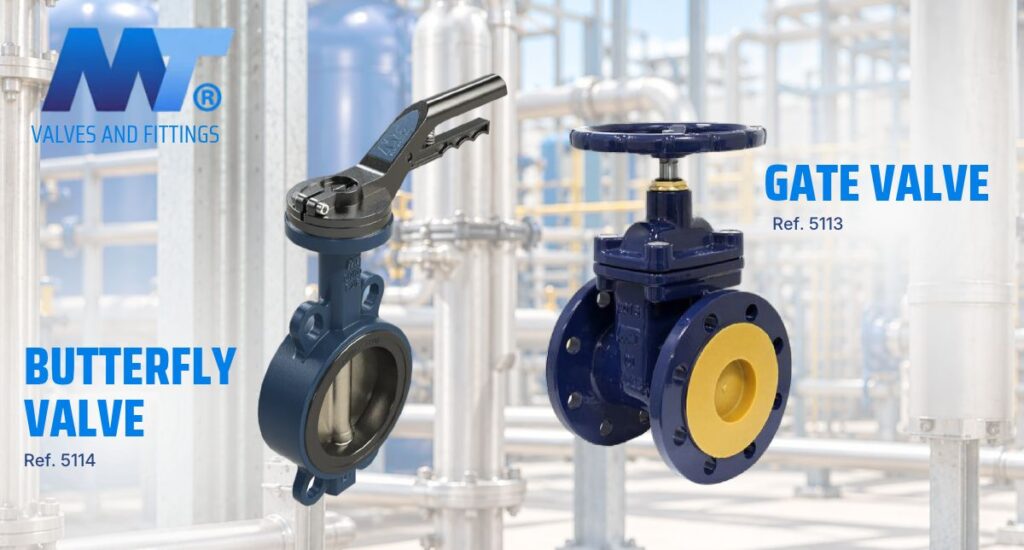
In many installations, choosing a valve seems straightforward until maintenance issues, pressure loss or space limitations begin to appear. Understanding the differences between a butterfly valve and a gate valve helps identify the most suitable option for the real operating conditions of the system.
How each type of valve works
The differences between a butterfly valve and a gate valve begin with their design and the way they regulate fluid flow. This directly affects installation space, operation and flow behaviour.
How a butterfly valve works
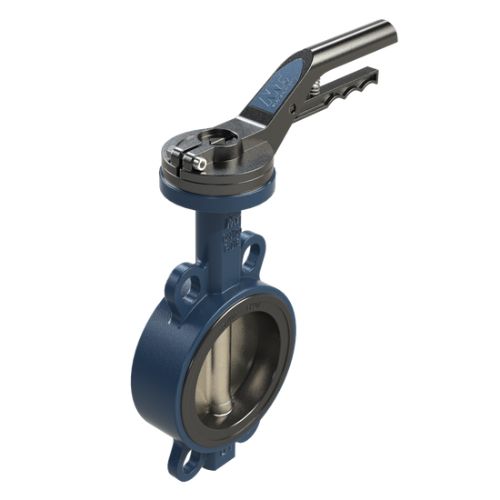
A butterfly valve uses a rotating disc to open or close the flow through a 90-degree turn. The disc remains inside the pipeline even when the valve is fully open.
Thanks to this design, butterfly valves are compact, lightweight and easy to operate. For this reason, they are widely used in large-diameter networks and systems where installation space is limited.
How a gate valve works
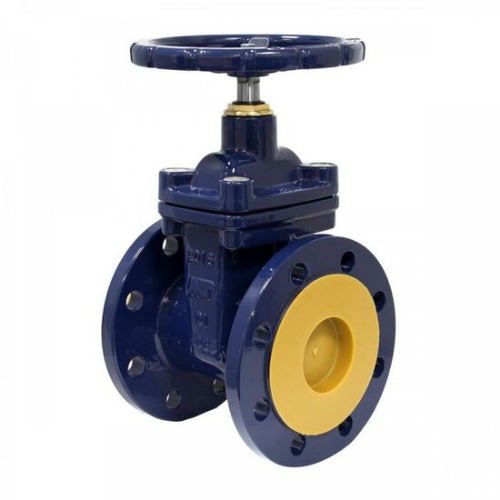
A gate valve operates through a sliding gate that moves up or down to open or close the flow. When fully open, the inside of the pipe remains clear so the flow can circulate normally.
This design minimises flow restriction inside the pipeline, which is especially useful in hydraulic systems where the valve remains open for long periods.
Main differences between butterfly valves and gate valves
When comparing a butterfly valve and a gate valve, it is important to consider several technical aspects related to system performance and installation requirements..
Space, weight and size
Butterfly valves require less installation space and are considerably lighter, especially in large diameters. Their reduced weight and compact size simplify both installation and operation.
Gate valves require more height to complete the opening and closing movement. In addition, the assembly is generally heavier and bulkier.
Pressure loss and flow behaviour
When a gate valve is fully open, fluid flows with very little restriction. For this reason, it is commonly used in systems where pressure loss must be kept to a minimum.
A butterfly valve keeps the disc inside the pipeline even when open. In many hydraulic systems this does not create a significant issue, although the flow path is not as clear as in a gate valve.
Maintenance and operating frequency
Butterfly valves provide fast and simple operation. Gate valves perform best when they remain fully open or fully closed for long periods.
If they operate constantly in intermediate positions, internal wear may increase and affect sealing performance.
Advantages of butterfly valves
Butterfly valves are widely used in industrial installations and HVAC systems where a compact and easy-to-operate solution is required.
Better adaptation to reduced spaces
Their compact design simplifies installation in systems with limited space or complex technical layouts.
Advantages in large diameters
In large dimensions, butterfly valves are lighter and easier to handle than gate valves, which simplifies installation work.
Fast and simple operation
Quarter-turn operation allows quick opening and closing. This is particularly useful in automated systems and installations with frequent valve operation.
Advantages of gate valves
Gate valves continue to be widely used in hydraulic systems where maintaining full flow capacity is a priority.
Full flow passage
When the valve is open, fluid circulates with minimal restriction. This helps maintain low pressure loss within the system.
In certain hydraulic installations, reducing pressure loss improves overall system efficiency and helps optimise energy consumption.
Reliable performance in continuous operation
Gate valves perform especially well in systems where they remain fully open or fully closed for long periods.
For this reason, they are commonly used in water distribution networks and piping systems operating under stable and continuous conditions.
*
How to choose the right valve for the installation
Choosing correctly between a butterfly valve and a gate valve depends on the actual operating conditions and requirements of the installation.
Available space and type of installation
When installation space is limited, butterfly valves adapt better thanks to their compact size and easier assembly.
Fluid type and operating conditions
Working pressure, temperature and fluid type directly influence valve selection. Not all installations require the same operating frequency or hydraulic behaviour.
Operating cost and maintenance
Maintenance requirements, accessibility and frequency of use may make one valve considerably more suitable than another depending on the installation.
Choosing the right valve helps reduce maintenance, avoid operating issues and maintain more stable system performance.